Coordinates /
Coordinate:
September 09.12,
Eranos Moscia (Open to registered / invited
Public)
CLICK Here for
Final program
CLICCA
qui per scaricare il Programma
Iscrizione
obbligatoria | Registration
is required
(vedi sotto) ............
.......(see
below)
Relatori /
Speakers /
Conférenciers:
- Nnnn Nnnn (Affiliation),
- Nnnn Nnnn (Affiliation),
- Nnnn Nnnn (Affiliation),
- Nnnn Nnnn (Affiliation),
Seminario dottorale
coordinato da: / Ph.D. Seminar chaired by /
Séminaire doctoral coordonné par: /
Doktorandenseminar koordiniert von:
In
collaborazione con il Dottorato di ricerca in Studi
umanistici transculturali, Università di Bergamo,
il Dottorato di ricerca in Filosofia, Università
di Pisa e Università di Firenze, il Dottorato di
ricerca in Scienze religiose, Facoltà di Teologia
di Lugano, il Dottorato di Ricerca in Studi Germanici e
Slavi, "Sapienza" Università di Roma e Univerzita
Karlova, Praha, e il Dottorato di Ricerca in Mutamento
sociale e politico, Università di Firenze e
Università di Torino
In collaboration with the Ph.D.
program in Transcultural Studies in Humanities,
University of Bergamo, the Ph.D. program in Philosophy,
University of Pisa and University of Florence, the Ph.D.
program in Religious Sciences, Faculty of Theology of
Lugano, the Ph.D. program in Germanic and Slavic Studies,
'Sapienza' University of Rome and Univerzita Karlova,
Praha, and the Ph.D. program in Social and Political
Change, University of Florence and University of
Turin
En collaboration avec
le Doctorat de recherche en Études humanistes
transculturelles, Université de Bergamo, le
Doctorat de recherche en Philosophie, Université
de Pise et Université de Florence, le Doctorat de
recherche en Sciences religieuses, Faculté de
Théologie de Lugano, le Doctorat de recherche en
études germaniques et slaves, « Sapienza
» Université de Rome et Univerzita Karlova,
Praha, et le Doctorat de recherche en Changement social
et politique, Université de Florence et
Université de Turin
In
Zusammenarbeit mit dem Doktorandenprogramm für
Transkulturellen Geisteswissenschaften, Universität
Bergamo, dem Doktorandenprogramm für Philosophie,
Universität Pisa und Universität Florenz, dem
dem Doktorandenprogramm für Religionswissenschaften,
Theologischen Fakultät Lugano, dem
Doktorandenprogramm für Germanistik und Slawistik,
„Sapienza" Universität Rom und Univerzita
Karlova, Praha, und dem Doktorandenprogramm für
Sozialem und politischem Wandel, Universität Florenz
und Universität Turin
Moderatori della
Scuola dottorale
- Dimitri D'Andrea (Università degli
Studi di Firenze - Dipartimento di Scienze Politiche e
Sociali)
- Adriano Fabris (Università di Pisa -
Dipartimento di Civiltà e Forme del Sapere;
Università della Svizzera Italiana USI -
Facoltà di Teologia di Lugano)
- Gabriele Guerra ("Sapienza" Università
di Roma - Dipartimento di Studi Europei, Americani e
Interculturali)
- Camilla Miglio ("Sapienza" Università
di Roma - Dipartimento di Studi Europei, Americani e
Interculturali)
- Amelia Valtolina (Università di
Bergamo - Dipartimento di Lettere, Filosofia,
Comunicazione)
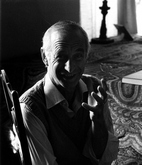
In memoriam
Dal 2021, la Fondazione Eranos
dedica i suoi Convegni annuali (Eranos Tagungen) a una
figura straordinaria della storia della medicina
contemporanea, il luminare Peter Anton Miescher
(1923-2020), e a sua moglie Annatina (1924-2016),
compagna di vita, interlocutrice privilegiata, pittrice
sensibile. Desidera così esprimere la sua
gratidune a due persone che in tempi e modalità
diverse hanno mostrato un grande affetto nei confornti
della dalla nostra istituzione. Pioniere nello
studio delle malattie autoimmuni, Peter Anton Miescher
è stato Professore di Medicina al Bellevue Medical
Center dell'Università di New York; Professore e
Direttore del Centro Trasfusionale e della Divisione di
Ematologia clinica e sperimentale all'Università
di Ginevra; Consulente di Immunoematologia clinica per
l'Organizzazione Mondiale della Sanità; e
Consulente per il Ministero della Sanità cinese. I
suoi studi teorici e sperimentali, così come la
sua pratica clinica, unite a uno spirito innovativo e
intrepido, gli hanno consentito di fare importanti
scoperte, il cui esito, in ultima analisi, è stato
quello di rivoluzionare la cura delle malattie
autoimmuni. Uomo di immensa cultura, collezionista e
musicista, umanista curioso, negli ultimi anni della sua
vita ha voluto condividere con la Fondazione Eranos
l'organizzazione di due simposi extra-muros, svoltisi
presso il museo del Castello di Tarasp (2018 e 2019),
sulle grandi questioni esistenziali che interessano oggi
le nostre società. L'amicizia di cui la Fondazione
ha potuto beneficiare si è anche tradotta in una
importante donazione, grazie alla quale sarà
possibile offrire al nostro pubblico un incontro annuale
di studio sui temi universali (l'arte, la
spiritualità, il senso della vita) che più
gli stavano a cuore. Una occasione per conservarne e
condividerne la memoria e dimostrare la nostra
gratitudine. Per questa ragione la Fondazione ha deciso
di proporrre all'interno della Tagung degli anni pari una
master lecture da parte di una personalità
scientifica che opera nel settore c^della
biomedicina.
Since 2021, the Eranos Foundation has dedicated their
annual Conferences (Eranos Tagungen) to an extraordinary
figure in the history of contemporary medicine, the
luminary Peter Anton Miescher (1923-2020), and to his
wife Annatina (1924-2016), a life companion, privileged
interlocutor, and sensitive painter. It thus wishes to
express its gratidune to two people who at different
times and in different ways showed great affection in
confornti of our institution. A pioneer in the study of
autoimmune diseases, Peter Anton Miescher was Professor
of Medicine at Bellevue Medical Center of New York
University; Professor and Director of the Transfusion
Center and Division of Clinical and Experimental
Hematology at the University of Geneva; Consultant of
Clinical Immunohematology to the World Health
Organization; and Consultant for the Chinese Ministry of
Health. His theoretical and experimental studies, as well
as his clinical practice, combined with an innovative and
intrepid spirit, allowed him to make important
discoveries whose outcome, ultimately, was to
revolutionize the treatment of autoimmune diseases. A man
of immense culture, collector and musician, curious
humanist, in the last years of his life he wanted to
share with the Eranos Foundation the organization of two
extra-muros symposia, held at the museum of Tarasp Castle
(2018 and 2019), on the great existential questions that
affect our societies today. The friendship from which the
Foundation was able to benefit also took the form of an
important donation, thanks to which it will be possible
to offer our audience an annual study meeting on the
universal themes (art, spirituality, the meaning of life)
that were most dear to him. An occasion to preserve and
share his memory and to show our gratitude. For this
reason , the Foundation had sdecided to propose in the
context of each Eranos Tagung a Master Lecture hold by a
renowned scientific personality active in the field of
biolmedicine.
Synopsis
.
Synopsis
.
Una società che fa dell'immediatezza il suo
principale alleato, tanto da definire "reale" quel tempo
che si afferma annullando sé stesso, è una
società che crede di poter fare a meno di tutte
quelle strutture di intermediazione dove la creazione del
valore (economico, sociale, individuale) emerge
attraverso la dimensione diacronica del tempo della
durata, anziché attraverso quella sincronica
dell'istantaneità. In un simile quadro, si impone
la questione di quale concezione di dèmos possa
ancora risultare plausibile e se sia ancora possibile
parlare di "popolo" in senso propriamente politico.
Può esserci ancora humanitas (il termine con cui
si nomina la solidarietà, la giustizia,
l'uguaglianza, il riconoscimento e quindi
l'inclusività) là dove l'individualismo
delle nostre società sembra essere solo in grado
di prestare attenzione alle necessità della
particolarità? E senza humanitas può ancora
darsi un dèmos così come lo hanno pensato
idealmente le democrazie moderne? E ancora: se proprio
non è possibile farne a meno, vi è modo di
pensare la particolarità senza dover rinunciare
all'universalità? Senza dunque cedere alle derive
regressive ed esclusiviste dell'éthnos? L'odierna
crisi della democrazia riflette l'affermarsi di
rivendicazioni identitarie dove le ragioni della
divisività fanno premio su quelle della coesione e
della mutua responsabilità. Ma là dove una
società perde il senso della comunità,
quale idea di dèmos può ancora
sopravvivere? ...
A society that makes immediacy its
main ally, to the extent that it defines as 'real' that
time which asserts itself by cancelling itself out, is a
society that believes it can do without all those
intermediary structures where the creation of value
(economic, social, individual) emerges through the
diachronic dimension of duration, rather than through the
synchronic dimension of instantaneity. In such a context,
the question arises as to what conception of dèmos
can still be plausible and whether it is still possible
to speak of 'people' in a strictly political sense. Can
there still be humanitas (the term used to refer to
solidarity, justice, equality, recognition, and therefore
inclusiveness) where the individualism of our societies
seems only capable of paying attention to the needs of
particularity? And without humanitas, can there still be
a dèmos as ideally conceived by modern
democracies? And again: if it is really impossible to do
without it, is there a way of thinking about
particularity without having to renounce universality?
Without, therefore, giving in to the regressive and
exclusivist tendencies of éthnos? Today's crisis
of democracy reflects the rise of identity claims where
the reasons for division take precedence over those of
cohesion and mutual responsibility. But where a society
loses its sense of community, what idea of démos
can still survive?
Une
société qui fait de
l'immédiateté son principal allié,
au point de définir comme « réel
» ce temps qui s'affirme en annulant soi-même,
est une société qui croit pouvoir se passer
de toutes ces structures d'intermédiation
où la création de valeur
(économique, sociale, individuelle) émerge
à travers la dimension diachronique du temps de la
durée, plutôt qu'à travers celle,
synchronique, de l'instantanéité. Dans un
tel contexte, la question se pose de savoir quelle
conception du dèmos peut encore être
plausible et s'il est encore possible de parler de «
peuple » au sens proprement politique. Peut-il
encore y avoir humanitas (le terme qui désigne la
solidarité, la justice, l'égalité,
la reconnaissance et donc l'inclusivité) là
où l'individualisme de nos sociétés
semble seulement capable de prêter attention aux
besoins de la particularité ? Et sans humanitas,
peut-il encore y avoir un dèmos tel que l'ont
idéalement conçu les démocraties
modernes ? Et encore : s'il n'est vraiment pas possible
de s'en passer, y a-t-il un moyen de penser la
particularité sans renoncer à
l'universalité ? Sans céder aux
dérives régressives et exclusivistes de
l'éthnos ? La crise actuelle de la
démocratie reflète l'affirmation de
revendications identitaires où les raisons de la
division l'emportent sur celles de la cohésion et
de la responsabilité mutuelle. Mais là
où une société perd le sens de la
communauté, quelle idée de dèmos
peut encore survivre ?...
Eine
Gesellschaft, die die Unmittelbarkeit zu ihrem
wichtigsten Verbündeten macht, so sehr, dass sie
jene Zeit als „real" definiert, die sich selbst
aufhebt, ist eine Gesellschaft, die glaubt, auf all jene
Vermittlungsstrukturen verzichten zu können, in
denen die Schaffung von (wirtschaftlichem, sozialem,
individuellem) Wert durch die diachrone Dimension der
Dauer und nicht durch die synchrone Dimension der
Unmittelbarkeit entsteht. In einem solchen Rahmen stellt
sich die Frage, welche Vorstellung von dèmos noch
plausibel sein kann und ob es noch möglich ist, im
eigentlichen politischen Sinne von „Volk" zu
sprechen. Kann es noch humanitas (der Begriff, mit dem
Solidarität, Gerechtigkeit, Gleichheit, Anerkennung
und damit Inklusivität bezeichnet werden) geben, wo
der Individualismus unserer Gesellschaften nur in der
Lage zu sein scheint, auf die Bedürfnisse der
Besonderheit zu achten? Und kann es ohne humanitas noch
einen dèmos geben, wie ihn sich die modernen
Demokratien idealerweise vorgestellt haben? Und weiter:
Wenn es wirklich nicht möglich ist, darauf zu
verzichten, gibt es dann eine Möglichkeit, das
Besondere zu denken, ohne auf das Allgemeine verzichten
zu müssen? Ohne also den regressiven und
exklusivistischen Tendenzen des éthnos
nachzugeben? Die heutige Krise der Demokratie spiegelt
das Aufkommen identitärer Forderungen wider, bei
denen die Gründe für Spaltung Vorrang vor denen
für Zusammenhalt und gegenseitige Verantwortung
haben. Aber wo eine Gesellschaft den Sinn für
Gemeinschaft verliert, welche Idee von dèmos kann
dann noch überleben?...
 .page
Top Program
.page
Top Program
Iscrizioni
Il Convegno è a numero chiuso. Per questa
ragione, l'iscrizione è obbligatoria.:
info@eranosfoundation.org, o telefonicamente, al numero
+41 (0)91 792 20 92
La
quota di partecipazione è di CHF 50.- per l'intero
Convegno e di CHF 25.- per le singole giornate.
Previa
registrazione al simposio, è prevista anche una
modalità di partecipazione a distanza.
https://us02web.zoom.us/j/84861923211
Trasporto.
A Eranos non vi sono parcheggi per automobili.
È possibile raggiungere Eranos con bus (n. 316) o
il taxi da Ascona
Pranzi.
La
quota per i pasti è di CHF 30.- /giorno. Si
raccomanda di iscriversi poiché non ci sono
opportunità di pranzare nelle immediate
vicinanze.
Lingue
Le conferenze sono in francese, Inglese oppure in
italiano a dipendenza del relatore
Registration
Please note that the Conference has limited places.
For this reason, advanced registration is required:
info@eranosfoundation.org,
or by phone at +41 (0) 91 792 20
92
The
registration fee is CHF 50.- for the entire Conference
and CHF 25.- for single day
sessions.
Upon
registration for the symposium, a distance mode of
participation will be also
provided.
https://us02web.zoom.us/j/84861923211
Transport.
Please, note that there are no parking places at
Eranos. You may reach Eranos from Ascona by bus (no. 316)
or by taxi cab.
Lunches.
The
fee for meals is of CHF 30.- /day,. It is recommended to
register for meals because thjere are no opportunities
nearby.
Language.
The conferences will be either in french, english or
in italian language, depending on the speaker.

.page
Top Program
**********************************************************************************************
Program /
Programma
Giovedì
11 settembre / Thursday
, September 11th
08h00-08h15 Registrazione
e accoglienza dei partecipanti al Convegno / Registration
and welcome of Conference participants / Inscription et
Acccueil des participants à la Conférence /
Registrierung und Empfang der
Tagungsteilnehmer
08h15-08h45 FABIO MERLINI
(Eranos Foundation, Ascona): Apertura del Convegno /
Opening of the Conference / Ouverture de la
Conférence / Eröffnung der Tagung
0845-0930 NNSPEAKER (xxLanguage)
"Title" (Part I)
.......
0930-0940
Pausa / Break / Pause / Pause
0940-1025 NNSPEAKER (CxxLanguage)
"Title" (Part II)
1025-1040 Discussione / Discussion / Discussion /
Diskussion
...................
1040-1105
Pausa caffè / Coffee break / Pause café
/ Kaffeepause
NNSPEAKER (CxxLanguage)
"Title" (Part I)
1150-1200 Pausa / Break / Pause / Pause
....................
NNSPEAKER
(CxxLanguage)
"Title" (Part II)
1245-1300 Discussione / Discussion / Discussion /
Diskussion
1300-1430 Lunch
1430-1515
NNSPEAKER
(CxxLanguage)
"Title" (Part I)
1515-1525 Pausa / Break / Pause / Pause
1525-1610 NNSPEAKER (CxxLanguage)
"Title" (Part II)
1610-1625 Discussione / Discussion / Discussion /
Diskussion
1625-1645 Pausa caffè / Coffee break / Pause
café / Kaffeepause
1645-1930 Tempo libero / Free time / Temps libre /
Freizeit
19h30 Hotel Ascona
Cena (riservata agli oratori e ai docenti) / Dinner
(reserved to lecturers and faculty) / Souper
(réservé aux orateurs et professeurs) /
Abendessen (reserviert für Redner und
Dozenten
Venerdì
12 settembre / Friday ,
September 12th
0830-0845 Accoglienza dei partecipanti
al Convegno /
Registration and welcome of Conference participants /
Inscription et Acccueil des participants à la
Conférence / Registrierung und Empfang der
Tagungsteilnehmer
0845-0930 NNSPEAKER (CxxLanguage)
"Title" (Part I)
0930-0940 Pausa / Break / Pause / Pause
0940-1025 NNSPEAKER (CxxLanguage)
"Title" (Part II)
1025-1040 Discussione / Discussion / Discussion /
Diskussion
1040-1105 Pausa caffè / Coffee break /
Pause café / Kaffeepause
1105-1150 NNSPEAKER (CxxLanguage)
"Title" (Part I)
1150-1200 Pausa / Break / Pause / Pause
1200-1245 NNSPEAKER (CxxLanguage)
"Title" (Part II)
1245-1300 Discussione / Discussion / Discussion /
Diskussion
1300-1430 Pranzo / Lunch / Dîner /
Mittagessen
1430-1515 NNSPEAKER (CxxLanguage)
"Title" (Part I)
1515-1525 Pausa / Break / Pause / Pause
1525-1610
NNSPEAKER
(CxxLanguage)
"Title" (Part I)
1610-1625 Discussione / Discussion / Discussion /
Diskussion
1625-1645 Pausa caffè / Coffee break / Pause
café / Kaffeepause
1645-1730 Tempo libero / Free time / Temps libre /
Freizeit
19h30 HOTEL SEESCHLOSS ASCONA Aperitivo e cena inaugurale
(riservata agli oratori e ai docenti)
Sabato,
13settembre / Saturday,
September 13th
Sala delle conferenze di Casa Eranos /
Lecture Hall of Eranos Hause / Salle de
Conférences de la Maison Eranos / Eranos-Haus
Tagungssaal
08h15-08h30 Accoglienza dei
partecipanti al Convegno / Welcome of Conference
participants / Acccueil des participants à la
Conférence / Empfang der
Tagungsteilnehmer
Seminario dottorale coordinato da /
Ph.D. Seminar chaired by / Séminaire doctoral
coordonné par / ließendes
Mittagessen
Partenze / Departures / Departs /
Abfahrten
.page
Top Program 2026
**********************************************************************************************
Profiles of Faculty and
Abstracts
Relatori e Abstract / Lecturers
and Abstracts / Conférenciers et
résumés
********************************************
« Title »
FIRST_LASTNAME
txtAbstract
FIRST_LASTNAME, txtProfile
********************************************
« Title »
FIRST_LASTNAME
txtAbstract
FIRST_LASTNAME, txtProfile
********************************************
« Title »
FIRST_LASTNAME
txtAbstract
FIRST_LASTNAME, txtProfile
****************************
********************************************
« Title »
FIRST_LASTNAME
txtAbstract
FIRST_LASTNAME, txtProfile
*********************************************
********************************************
« Title »
FIRST_LASTNAME
txtAbstract
FIRST_LASTNAME, txtProfile
********************************************
« Title »
FIRST_LASTNAME
txtAbstract
FIRST_LASTNAME, txtProfile
..
..
 ....
..
....
.. .
.....
.
..... ...
... ..........PDF
PROGRAM 2026
..........PDF
PROGRAM 2026


 ..,
.., .
.

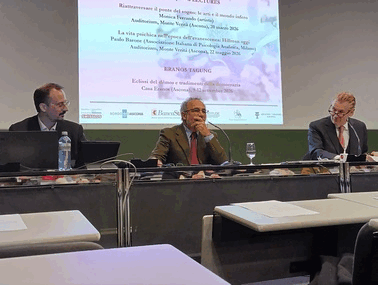
 Since
2011, the Eranos Foundation focussed part of its program
to the series of evening conferences called
Eranos-Jung Lecures and held at the Monte
Verità.
Since
2011, the Eranos Foundation focussed part of its program
to the series of evening conferences called
Eranos-Jung Lecures and held at the Monte
Verità. Dal
2011 la nostra Fondazione ha integrato nel suo programma
le cosiddette Eranos-Jung Lectures,
conferenze serali al Monte Verità che hanno
regoiarmente avuto un grande successo.
Dal
2011 la nostra Fondazione ha integrato nel suo programma
le cosiddette Eranos-Jung Lectures,
conferenze serali al Monte Verità che hanno
regoiarmente avuto un grande successo.

 ..
..
 ..
..
 ..
..
 ..
..
 ...
...


 .
.
